
Charles Omenihu's estimated net worth as of April 2026 is in the range of $3 million to $6 million. That range reflects cumulative NFL earnings since his 2019 rookie contract, minus taxes, living expenses, and money forfeited during his 2023 suspension, with a realistic but uncertain allowance for any savings or investments accumulated along the way. No public figure or audited financial statement exists for him, so this estimate is built from contract data rather than guesswork from celebrity net-worth aggregators.
Charles Omenihu Net Worth: Estimated Value and How It’s Calculated

Marcus Redfield
17 Apr 2026
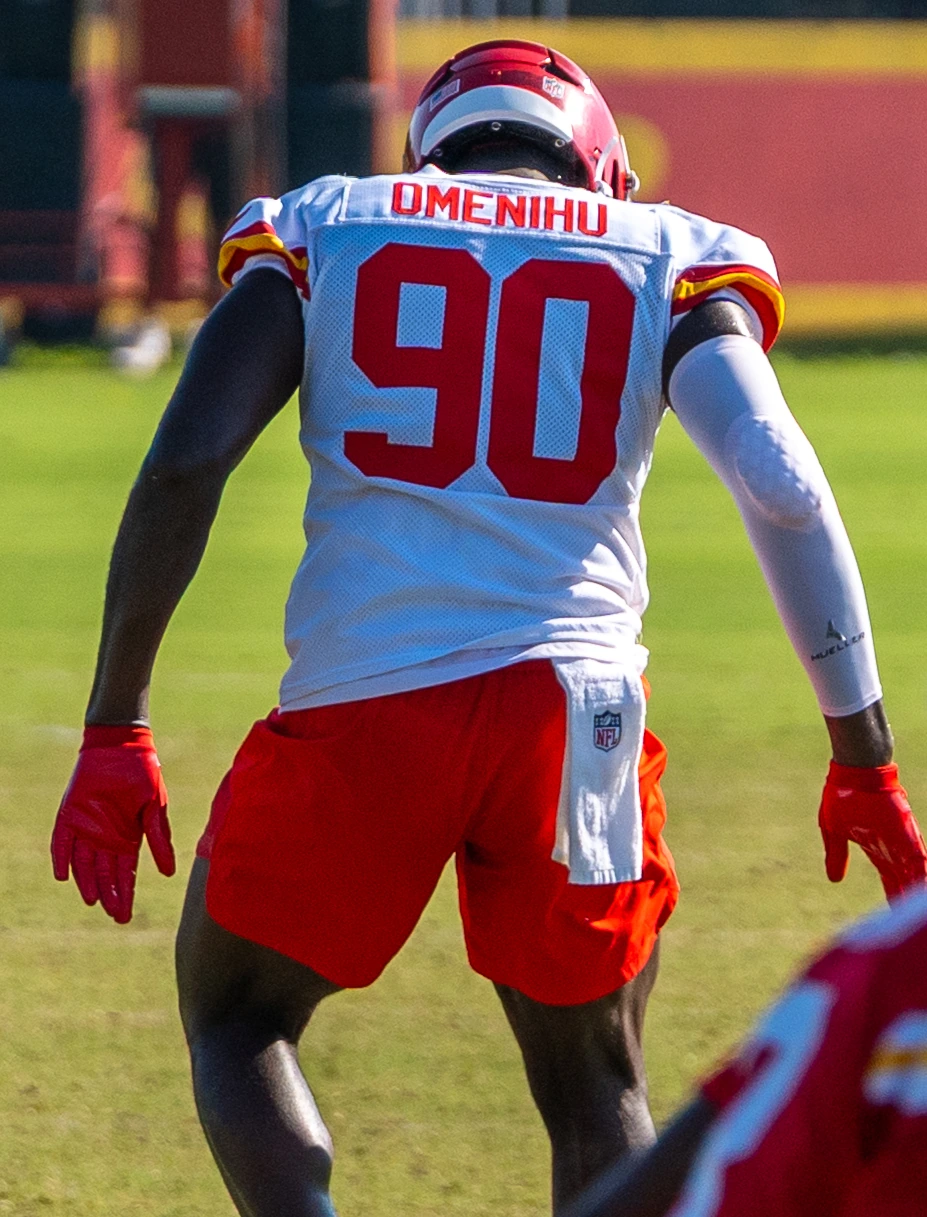
Who Charles Omenihu Is
Charles Omenihu (born August 20, 1997) is an NFL defensive end currently playing for the Washington Commanders. The reason you need a quick disambiguation here is that this site covers many prominent Charles figures, from Charles Oppenheimer's net worth to athletes and entrepreneurs, so it's worth confirming upfront: this article is about the NFL pass rusher, not any other person sharing the name. Omenihu was drafted in the 5th round (161st overall) of the 2019 NFL Draft by the Houston Texans. He has since played for the San Francisco 49ers, the Kansas City Chiefs (twice), and most recently signed with Washington for the 2026 season.
His Estimated Net Worth Right Now
The honest answer is that net-worth estimates for mid-tier NFL players like Omenihu vary significantly depending on who is doing the math. Sites like NetWorthGenius have published figures in the $1M–$5M range (as of a March 2024 estimate), while CollegeNetWorth.com has claimed $5M–$8M, and other sources peg it around $3M. None of these sites publish a transparent methodology. The most defensible approach is to model it from the ground up using blank" rel="noopener noreferrer">contract databases like Spotrac and OverTheCap, which is exactly what this breakdown does.
Starting from total documented NFL earnings and working backward through taxes and known deductions, a $3M–$6M range is the most realistic estimate for April 2026. The low end assumes he spent and lost to taxes at a rate typical for NFL players in high-tax states; the high end assumes disciplined saving and some investment growth. The truth is almost certainly somewhere in between.
Where His Money Comes From
NFL Salary and Signing Bonuses
NFL salary is by far his primary income source, and it's the one thing we can quantify with reasonable precision. His 2026 deal with the Washington Commanders, per NBC Sports, is a one-year, $4 million contract. Spotrac breaks that down as a $2.3 million base salary, a $1 million signing bonus, and a $190,000 workout bonus, producing a $4 million cap hit. Signing bonuses are paid upfront (and are typically fully guaranteed), so the $1 million landed in his account at signing regardless of what happens during the season.
Incentives
Incentives are part of the contract picture but are genuinely hard to count on. During his 2023 Chiefs deal, Arrowhead Pride noted that his incentive packages were broken into $500,000 payments tied to thresholds like playing at least 65% of defensive snaps, plus additional playoff achievement bonuses. These are real money, but they are contingent and should be treated as upside rather than guaranteed earnings.
Endorsements and Sponsorships
There is no publicly documented evidence of significant brand endorsement deals for Omenihu. He is not a household-name player in the mold of a quarterback or top-10 draft pick, which means national sponsorship revenue is unlikely to be material to his net worth. He does appear in the NFL's MyCauseMyCleats charitable program and runs a youth football camp through Legacy Philanthropy, but these are community activities, not significant income sources.
His Contract and Earnings Timeline
| Year(s) | Team | Contract Details | Notable Notes |
|---|---|---|---|
| 2019–2022 | Houston Texans / San Francisco 49ers | 5th-round rookie contract; OverTheCap shows 2019 base salary ~$2.82M with a prorated signing bonus of ~$704K | Developed as a rotational pass rusher; traded to 49ers during this window |
| 2023–2024 | Kansas City Chiefs | 2-year, $16M deal; $8.6M guaranteed at signing (per ESPN and Arrowhead Pride) | Suspended 6 games in 2023 for personal conduct violation, forfeiting a portion of 2023 salary |
| 2025 | Kansas City Chiefs (re-signed) | 1-year deal, max value up to $7M (per ESPN, March 20, 2025) | Return after ACL recovery; confirmed by Chiefs press release March 27, 2025 |
| 2026 | Washington Commanders | 1-year, $4M deal; $2.3M base + $1M signing bonus + $190K workout bonus (Spotrac) | Current active contract as of April 2026 |
Adding up the headline contract values across his career: a standard 5th-round rookie deal (roughly $3M–$4M total over four years), the two-year $16M Chiefs deal, the one-year $7M max Chiefs return, and the current $4M Commanders deal puts gross career contract value in the neighborhood of $30M–$31M before any adjustments. That's a ceiling, not a floor. Cash actually received is lower once you strip out suspended game checks, contingent incentives that weren't earned, and the proration timing difference between cap accounting and real cash flow.
What Affects How Much He Actually Keeps
Taxes

This is the single biggest haircut on any NFL player's earnings. NFL players pay federal income tax at the top marginal rate (37% on income above roughly $609,000 as of recent years), plus state and local taxes that vary by game location (the so-called "jock tax"). Playing home games in Texas (no state income tax), California (up to 13.3%), Missouri, and Washington D.C. across his career means his effective combined tax rate has likely averaged somewhere between 45% and 52% on earned income. On $30M in gross career earnings, that's potentially $14M–$16M in taxes alone.
The 2023 Suspension
blank" rel="noopener noreferrer">ESPN reported that Omenihu was suspended for six games in 2023 under the NFL's personal conduct policy. Suspended players typically forfeit their weekly game checks for those games. On a $16M two-year deal, six missed game checks represent a meaningful chunk of his 2023 cash, and this is a reason why gross contract value is not the same as money in the bank. OverTheCap's suspension-adjusted fields help model this distinction.
Living Expenses and Lifestyle
There's no public reporting on Omenihu's spending habits, real estate holdings, or personal financial decisions, which is fairly typical for a player at his career level. Standard assumptions for NFL players include significant housing costs in NFL cities, agent fees (typically 3% of contract value), financial advisor fees, and the general cost of maintaining a professional athlete lifestyle. These are real drags on net worth but can't be precisely quantified from public data.
Investing and Philanthropy
No public record documents specific investments, real estate portfolios, or business ventures for Omenihu. His youth football camp (run through Legacy Philanthropy) shows community engagement, which is a positive signal about character but not a financial driver in either direction. If he has invested wisely, his net worth could be meaningfully above the $3M–$6M estimate; if not, it could be at the low end.
How to Check These Numbers Yourself

If you want to verify or update this estimate, here's the practical approach. Start with the contract databases. Spotrac and OverTheCap are the gold standard for NFL contract mechanics: they break down base salary, signing bonus, workout bonus, roster bonus, guaranteed amounts, and cap charges year by year. These are not audited financials, but they are the most accurate publicly available income inputs for any NFL player.
- Go to Spotrac or OverTheCap and search "Charles Omenihu" to see his current and historical contract breakdowns, including guaranteed amounts vs. non-guaranteed components.
- Cross-reference with official NFL team press releases (e.g., Chiefs.com or Commanders.com) for signing confirmations and any stated guaranteed figures.
- Check NFL.com's career stats page for Omenihu to confirm seasons played, games started, and snap counts, which tell you whether incentive thresholds were likely met.
- Use ESPN's transaction news to catch any in-season events (suspension, injury settlement, restructure) that might change cash actually received.
- Treat net-worth aggregator sites ($1M–$8M estimates from various sources) as rough directional signals only, not authoritative figures.
This is a similar methodology to what you'd use when researching other athletes on this site. For context, the process of reconciling contract data with public career timelines applies whether you're looking at a football player like Omenihu or reading about Charles Ollivon's net worth in rugby, where contract databases are less comprehensive and estimates carry even more uncertainty.
Common Misconceptions About Net Worth Estimates
"Contract value" is not the same as net worth
This is the most common mistake. When you see "Omenihu signed a $16M deal" or a "$7M max contract," that is the total contract value before taxes, agent fees, and contingent incentive adjustments. The cap hit number you see in NFL salary databases is an accounting figure for the team's salary-cap purposes and uses prorated signing bonus math that doesn't reflect the actual timing of cash payments to the player. Net worth is what's left after all outflows: taxes, spending, agent cuts, and any debt.
Incentives are often not earned
Playing-time-based incentives (like the $500,000 snap-count thresholds Omenihu had with the Chiefs) are only paid if the player meets the condition. An ACL injury in 2024, the kind of setback that prompted his cautious return on a one-year deal in 2025, is exactly the sort of event that wipes out incentive earnings entirely. When a contract is described as "up to $7M," the "up to" part is doing a lot of work.
Net worth is not liquid cash
Even if Omenihu's net worth is $5M, that doesn't mean he has $5M sitting in a checking account. Net worth is assets minus liabilities: it could include real estate equity, retirement accounts, investment portfolios, and vehicles, all of which have varying degrees of liquidity. This is worth keeping in mind for any wealth profile on this site, whether it's an NFL player or a figure like Marion Oatsie Charles, where the composition of wealth matters as much as the headline figure.
Net-worth aggregator sites are not auditors
Sites that publish a single clean number like "Charles Omenihu net worth: $3M" are making an estimate, usually without disclosing how they got there. The wide variance across sites ($1M to $8M in this case) is a direct consequence of using different input assumptions and not modeling taxes, spending, or suspension effects. Think of them as a starting-point sanity check, not a financial statement. For anyone doing serious research, the same transparency standard we'd apply to estimating Charles Ommanney's net worth or any other figure on this site applies here: always trace the number back to documented income sources.
The Bottom Line
Charles Omenihu's most defensible estimated net worth as of April 2026 is $3 million to $6 million. He has earned somewhere in the neighborhood of $30M in gross career contract value across seven NFL seasons, but after federal and state taxes (likely consuming 45%–52% of income), six suspended game checks in 2023, agent and advisor fees, and normal living expenses, the realistic retained wealth figure is considerably lower than the headline contract numbers suggest. His current $4M Commanders deal adds fresh income in 2026, and if he stays healthy and hits incentive thresholds, the high end of the range becomes more achievable. For the most current and accurate picture, check Spotrac and OverTheCap directly and cross-reference with any new signing news from the Washington Commanders.
FAQ
How can I estimate Charles Omenihu’s cash-in-bank, not just his contract value?
You can approximate cash received by using the guaranteed money and only counting incentives you can reasonably verify as earned, then subtract estimated taxes at an effective rate that matches where he actually played that season (plus agent fees). This typically produces a lower “spendable” number than the widely posted contract totals.
Why could his actual net worth be higher or lower than the $3M to $6M range even after taxes?
Yes, the estimate can be understated if he built wealth through early savings, employer retirement plans (if available), or low-cost index investing, but it can also be overstated if he took on debt or had high fixed costs. The article’s range assumes no major windfall investment outcomes, so the net worth could move both directions.
Should I include incentive money when calculating Charles Omenihu net worth estimates?
A good rule is to treat “up to” incentives as zero unless the season transcript shows he met the specific thresholds (for example, snap-percentage or postseason qualification). If the thresholds are unclear or not publicly broken down, keep them out of your base calculation.
Why do Spotrac and OverTheCap sometimes show different numbers for the same player?
Spotrac and OverTheCap can differ because they may model roster bonuses, proration timing, or cap charges slightly differently, even if the underlying contract is the same. If you want a consistent approach, pick one source for the year-by-year cash flow inputs and use the other as a cross-check.
Does a high salary cap hit always mean Charles Omenihu received more cash that year?
Not necessarily. Signing bonuses are usually paid upfront, but what you see as cap hit is accounting proration spread over the contract length. Net worth tracks assets, so a year with a “low cap hit” can still be a year with significant cash if the bonus was paid.
What’s the biggest way the 2023 suspension changes a net worth calculation?
A suspension mainly affects weekly base game checks, but it can also reduce the chance of earning performance-based incentives tied to playing time. So for 2023, you should haircut both the missed-game salary and any snap-threshold bonuses you would otherwise assume.
Could endorsements or brand deals meaningfully change Charles Omenihu net worth?
It’s usually small for players outside the top tier, but it can matter if he had local sponsorships or social media deals. Because there is no reliable public disclosure of endorsement revenue here, the safest estimate is to exclude major brand income and treat community programs as non-income.
How should agent fees be handled when estimating his net worth?
Agent fees and advisory fees typically reduce net worth in a way that contract totals do not show. A simple sensitivity check is to apply an estimated percentage to gross earned income (or to contract value where appropriate) and then compare how much the range tightens or widens.
What’s a practical step-by-step method to recreate the estimate from scratch?
Use a timeline approach: start with rookie signing and guaranteed amounts, add subsequent guaranteed money from each contract, then subtract the estimated outflows (taxes, agent fees, routine living costs). Finally, add a conservative assumption for returns on savings, rather than assuming he invested like a professional investor.
How do injuries like the 2024 ACL impact net worth, beyond missing games?
Yes, injury timing can reduce incentives and also affect subsequent contract size and guarantee levels. For example, if he misses time around a threshold-based incentive or enters a lower-guarantee deal, the retained wealth can be much lower than you’d expect from headline “up to” values.